Specialist dentistry, shaped around you.
 Consultations at Yoyime Clinic · Deira, Dubai

Dental Crowns in Dubai
Dental crowns for a damaged tooth.
Explore when a crown can help, when a smaller restoration may be enough, and what makes the choice right for your tooth.

Discuss this with Dr. Aliveni Sowjanya · Specialist Prosthodontist

01
Purpose
Restore a weakened tooth
02
Decision
How much sound tooth remains?
03
Commitment
Ongoing cleaning and review
01
Does this tooth need a crown?
The starting point is the tooth underneath—not the material on top.

Large or failing fillings
A crown may be considered when substantial tooth structure is missing or the remaining walls need protection.
Cracks, wear or root treatment
A damaged or heavily restored tooth may benefit from coverage. Root canal treatment alone does not mean every tooth automatically needs a crown.
A smaller option may be enough
A filling or an onlay can sometimes restore the tooth while retaining more natural structure. Ask why a full crown is recommended in your case.
A closer look
From laboratory work to tooth coverage.
The photograph shows ceramic restorations during laboratory firing. The diagram explains coverage; an assessment determines what remaining tooth structure can be preserved.

How it works · simplified
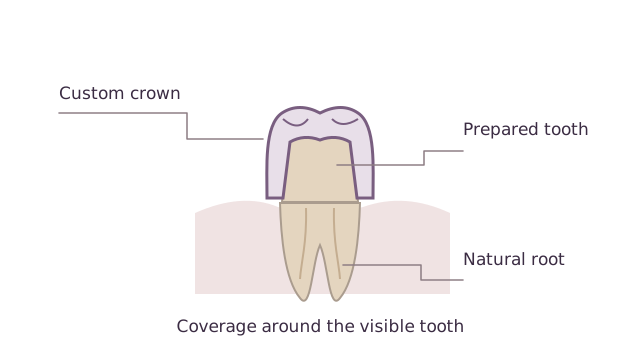
A crown covers the prepared visible part of a tooth. The natural roots remain below the gum.Simplified illustration · not a treatment recommendation.
02
From assessment to fit
The sequence depends on the tooth, the material and any treatment needed first.
1
Check the foundation
The assessment considers decay, gums, remaining tooth, bite and symptoms. Further investigations or treatment may be needed before a crown is appropriate.
2
Prepare and record
The tooth is reshaped, and a scan or impression records its form. A temporary restoration may protect it while the final crown is made.
3
Check before final placement
Fit, contacts, bite and appearance need assessment. Discuss colour and shape before the crown is definitively secured.
From a question to a restoration
Know what each stage is for.
A well-explained plan makes it easier to understand the next decision.
01


Assess
Understand the tooth, your symptoms, available options and any treatment needed first.
02

Prepare & record
Plan the preparation and take the appropriate scan or impression. Discuss any temporary restoration.
03

Check & fit
Assess the restoration’s fit, bite and appearance before final placement.
04

Care & review
Learn how to clean it and when to return if comfort, fit or function changes.
The exact sequence varies with the tooth, restoration and clinical findings. A same-day result is not assumed.
03
The trade-offs deserve attention
A crown restores a tooth; it does not make it maintenance-free.

Tooth preparation is irreversible
Some natural tooth must be removed. Sensitivity can follow; occasionally the tooth may later need root canal treatment.
Material is a clinical choice
Ceramic, metal and combined designs have different strengths and aesthetic characteristics. The best option depends on the location, available space, bite and remaining tooth.
Plan for the years after fitting
Decay can develop at the edges, and a crown may chip or loosen. Brush with fluoride toothpaste, clean between teeth and attend reviews. Report pain, a changed bite or movement.
A little more detail
Your questions, answered.
Shade, shape and proportions can be planned to harmonise with nearby teeth. The underlying tooth colour, gum position and material affect what is achievable.
Neither is automatically better. An onlay covers part of the tooth; a crown provides more complete coverage. The remaining structure and clinical risks guide the decision.
There is no guaranteed lifespan. Tooth condition, bite, material, cleaning and follow-up all matter. Ask about repair and replacement as part of the plan.
Request a written quotation that separates the crown from any core build-up, root canal treatment, temporary restoration or other work needed first.
Discuss your previous experiences and comfort concerns before treatment. Local anaesthetic is commonly used for preparation; tell the clinician if you feel discomfort.
Sources & how to use this information
This page provides general education, not a diagnosis or a personalised treatment plan. Ask your treating clinician how it applies to you.

Keep exploring
Your next useful read.

Your next chapter
Start with a conversation.
Bring your questions. Understand your choices. Decide with clarity.
Consultations at Yoyime Clinic · Deira, Dubai

