Specialist dentistry, shaped around you.
 Consultations at Yoyime Clinic · Deira, Dubai

The patient guide
How much of the tooth needs protection?
An onlay covers selected weakened areas, including part of the biting surface. A crown covers more of the tooth. The goal is suitable protection while preserving useful structure.

Discuss this with Dr. Aliveni Sowjanya · Specialist Prosthodontist

01
Onlay
Partial coverage
02
Crown
More extensive coverage
03
Decision
Based on what remains
Side by side
A clearer comparison.
| What to consider | Onlay | Crown |
|---|---|---|
| Coverage | Selected biting surfaces and weakened cusps | More of the visible tooth |
| What to ask | Can remaining walls be preserved safely? | Why is this extent of coverage needed? |
| Shared requirement | Appropriate design, care and review | Appropriate design, care and review |
01
Start with the shape of the damage
Treatment names should follow the condition of the tooth.

A limited area of weakness
An onlay may be considered where the dentist can retain useful tooth structure while covering weakened parts of the biting surface.
More widespread damage
A crown may be considered when the tooth needs more extensive coverage. Ask which findings make that amount of coverage necessary.
A smaller repair
A filling can be appropriate in some situations. Ask whether an indirect restoration is needed and what it would add for this tooth.
A closer look
Understand how much coverage is needed.
The diagram explains partial coverage. The photograph illustrates ceramic laboratory work; it is not a close-up of an inlay or onlay.

How it works · simplified
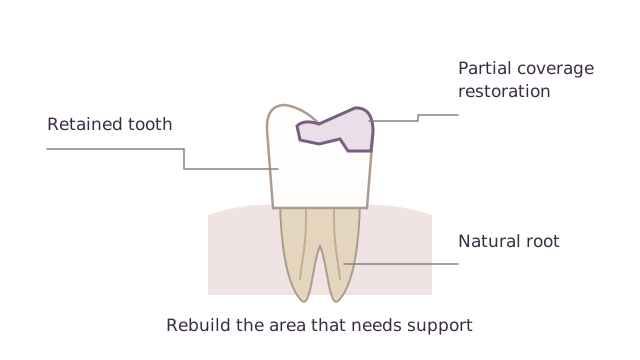
An onlay replaces part of the chewing surface and may cover one or more cusps while retaining suitable natural tooth structure.Simplified illustration · not a treatment recommendation.
02
Why the same choice does not fit every tooth
The visible size of an old filling is only one part of the assessment.
1
Remaining tooth and cracks
Ask which parts are healthy and which are weak. The position of the damage and the condition beneath old work can affect the design.
2
Bite and available space
The replacement needs room and a suitable shape for function. Discuss grinding or previous restoration fractures with the dentist.
3
Material and attachment
An onlay is not just a smaller crown made the same way. Ask how the design will be retained and why the chosen material suits it.
03
Questions before agreeing
A short explanation can make a technical decision much easier to understand.

Show me the coverage
Ask the clinician to mark which surfaces will be restored and which can remain. A drawing or model is useful here.
Explain the alternative
What would change if a crown were chosen instead? What is the limitation of a filling or an onlay in this particular case?
Tell me the review plan
Ask how bite, fit and cleaning will be checked. Report persistent discomfort or a change in the way your teeth meet after treatment.
A little more detail
Your questions, answered.
It provides partial coverage, but suitability depends on the damaged tooth and the preparation needed. Ask how much healthy tooth each option would preserve.
No. An inlay generally fits within the biting surface; an onlay extends over one or more weakened cusps or parts of that surface.
Sometimes, but the remaining structure, tooth position and loading need assessment. Root treatment alone does not determine the final design.
No. The remaining natural tooth still needs cleaning and dental review, especially at the junction with the restoration.
Sources & how to use this information
This page provides general education, not a diagnosis or a personalised treatment plan. Ask your treating clinician how it applies to you.

Keep exploring
Your next useful read.

Your next chapter
Start with a conversation.
Bring your questions. Understand your choices. Decide with clarity.
Consultations at Yoyime Clinic · Deira, Dubai

