Specialist dentistry, shaped around you.
 Consultations at Yoyime Clinic · Deira, Dubai

Your concern · Existing dental work
When dental work no longer feels right.
A loose crown, a rough edge or discomfort on biting deserves an explanation. Replacing the visible restoration is only one possibility; the supporting tooth and tissues need attention too.

Discuss this with Dr. Aliveni Sowjanya · Specialist Prosthodontist

01
Tell us
What changed and when
02
Bring
Previous records and loose parts
03
Main question
Can it be repaired—or should it be replaced?
01
Start with the symptom, not a replacement order.
Different problems can feel similar to a patient.

Notice the changes
Explain whether the restoration moves, traps food, tastes unpleasant or hurts on biting. Mention recent treatment and any earlier root-canal work. These details guide the examination; they do not establish the diagnosis.
Check the foundation
The assessment may include the supporting tooth, gum health, fit and biting contacts. Imaging or additional tests may be appropriate. A restoration that looks intact can still need investigation.
A closer look
From laboratory work to tooth coverage.
The photograph shows ceramic restorations during laboratory firing. The diagram explains coverage; an assessment determines what remaining tooth structure can be preserved.

How it works · simplified
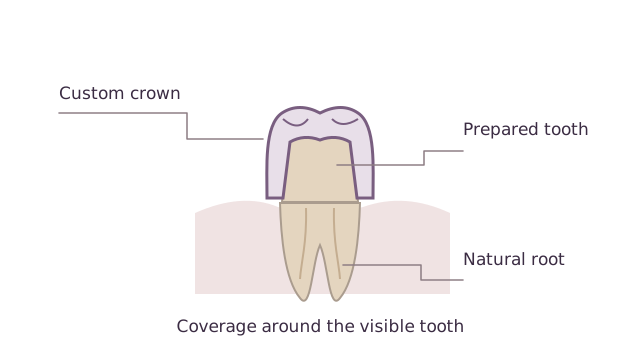
A crown covers the prepared visible part of a tooth. The natural roots remain below the gum.Simplified illustration · not a treatment recommendation.
02
Preserve what can be maintained.
Ask for the reasoning behind repair, replacement or another approach.
1
Repair or reattach where suitable
A small defect or loss of retention may be manageable without replacing everything. The condition of the restoration and underlying tooth determines whether this is a reliable option.
2
Replace when the foundation or design requires it
Replacement may be needed if damage, decay or fit problems cannot be resolved conservatively. If a supporting tooth cannot be retained, the replacement plan may need to change rather than simply copying the old bridge.
03
Make the next restoration easier to live with.
Use the review to clarify both the immediate problem and future maintenance.

Discuss the interim stage
Ask whether you will need a temporary restoration and what limits it may have. Plan around work, eating and any visible gap before removal of existing dental work.
Clarify the full estimate
Ask whether the quote includes removal, tests, temporary work and laboratory stages. Additional treatment can become necessary after removal reveals the tooth underneath; discuss how decisions and costs will be communicated.
A little more detail
Your questions, answered.
No. A problem with a crown does not automatically mean the tooth is beyond repair. The decision depends on the remaining tooth, root and surrounding tissues.
Shade, shape and translucency can be considered in the design. Matching a single visible tooth can be demanding, so discuss realistic expectations and the opportunity to assess appearance before final fitting.
No. Keep the part safely and contact a dentist. Household adhesives are not intended for the mouth, and a loose part may pose a swallowing or inhalation risk.
No restoration has a guaranteed lifetime. Tooth health, hygiene, bite forces, material and maintenance all influence what happens over time. Ask how to recognise a problem early.
Sources & how to use this information
This page provides general education, not a diagnosis or a personalised treatment plan. Ask your treating clinician how it applies to you.

Keep exploring
Your next useful read.

Your next chapter
Start with a conversation.
Bring your questions. Understand your choices. Decide with clarity.
Consultations at Yoyime Clinic · Deira, Dubai

