Specialist dentistry, shaped around you.
 Consultations at Yoyime Clinic · Deira, Dubai

Dental Bridges in Dubai
Dental bridges. Understand the choices.
A bridge can replace missing teeth without a removable plate. The important question is how it will be supported—and what that means for nearby teeth.

Discuss this with Dr. Aliveni Sowjanya · Specialist Prosthodontist

01
Purpose
Replace one or more missing teeth
02
Support
Teeth or dental implants
03
Daily care
Clean beneath the replacement tooth
01
Different bridges, different compromises
The gap alone does not determine the design.

Conventional bridge
A replacement tooth is joined to crowns on supporting teeth. Those teeth usually need reshaping; their health and strength are central to the decision.
Adhesive bridge
A bonded wing supports a replacement tooth in selected situations. This may preserve more neighbouring tooth structure, but it can come loose and is not suitable for every bite or gap.
Implant-supported bridge
An alternative supported by implants rather than neighbouring teeth. This involves assessment of implant suitability and a separate surgical phase.
A closer look
Different ways to support replacement teeth.
The bridge shown above is a connected restoration. This separate photograph identifies the implant, abutment and crown in a single implant-supported example.

How it works · simplified
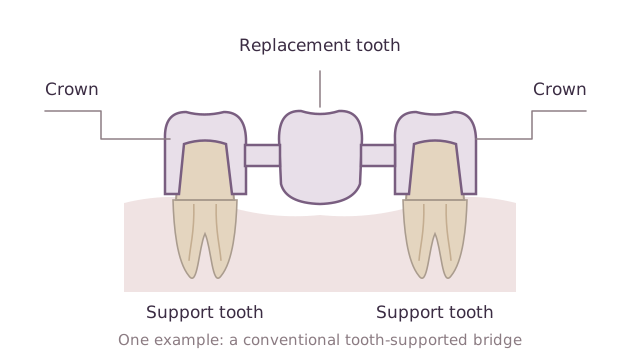
A conventional three-unit bridge uses crowns on adjacent teeth to support an artificial tooth across a gap.Simplified illustration · not a treatment recommendation.
02
What the assessment needs to answer
A useful plan explains more than the number of teeth being replaced.
1
Is the support reliable?
The supporting teeth, gums, bite and size of the space need evaluation. Existing crowns or large fillings can affect the choice.
2
What will the bridge feel like?
Discuss the expected appearance, chewing, speech and cleaning access. Ask whether a temporary replacement is needed while the bridge is being made.
3
What are the other options?
Compare an implant restoration, a removable partial denture and, where clinically acceptable, monitoring the space without replacement.
03
Looking after the whole bridge
The supporting teeth need as much attention as the new tooth.

Clean underneath
A fixed bridge stays in place. Your clinician can demonstrate suitable floss or interdental aids to clean beneath the replacement tooth and around its supports.
Know the possible problems
A bridge can loosen or chip. Supporting teeth can develop decay, gum problems or nerve symptoms; some may later require root canal treatment.
Return when something changes
Movement, a changed bite, food trapping or persistent soreness deserve review. A loose bridge should not be glued back with household adhesives.
A little more detail
Your questions, answered.
The right choice depends on the neighbouring teeth, gum and bone health, surgical suitability, maintenance and your preferences. Compare the complete treatment plans, not only the first quoted price.
A conventional bridge generally requires preparation of supporting teeth. An adhesive bridge may involve much less preparation. Ask which design is proposed and why.
A fixed bridge is not removed by you. Cleaning beneath and around it is essential; ask for a practical demonstration before treatment is complete.
Timing depends on the design, laboratory stages and whether other teeth or gums need treatment first. Request an individual sequence and temporary-tooth plan.
Not necessarily. The effect on chewing, appearance and the surrounding teeth matters. Discuss whether observation is a reasonable option for your particular space.
Sources & how to use this information
This page provides general education, not a diagnosis or a personalised treatment plan. Ask your treating clinician how it applies to you.

Keep exploring
Your next useful read.

Your next chapter
Start with a conversation.
Bring your questions. Understand your choices. Decide with clarity.
Consultations at Yoyime Clinic · Deira, Dubai

