Specialist dentistry, shaped around you.
 Consultations at Yoyime Clinic · Deira, Dubai

The patient guide
A bridge or an implant? Start with the support.
Both can replace a missing tooth. The important difference is what supports the replacement—and what that means for your existing teeth, treatment and care.

Discuss this with Dr. Aliveni Sowjanya · Specialist Prosthodontist

01
Bridge
Usually supported by teeth
02
Implant restoration
Supported by an implant
03
Decision
Suitability comes before preference
Side by side
A clearer comparison.
| What to consider | Tooth-supported bridge | Implant-supported tooth |
|---|---|---|
| Support | Natural teeth in tooth-supported designs | An implant placed in the jaw |
| Main planning question | Can the supporting teeth carry the bridge? | Are surgery and implant support suitable? |
| Care | Clean teeth and beneath the replacement tooth | Clean around the restoration and monitor implant tissues |
01
Three questions change the comparison
An option that works well for one person may make little sense for another.

Are neighbouring teeth healthy?
A conventional bridge usually needs preparation of supporting teeth. An adhesive bridge may require less preparation in suitable situations. Ask which design is proposed.
Is implant treatment suitable?
Bone, gum health, medical history and the available space affect planning. Implant placement involves surgery; the crown or bridge fitted onto it is the restorative stage.
What can you maintain?
Ask to see how to clean under a bridge or around an implant crown. An attractive replacement still needs access for daily care.
A closer look
Different ways to support replacement teeth.
The bridge shown above is a connected restoration. This separate photograph identifies the implant, abutment and crown in a single implant-supported example.

How it works · simplified
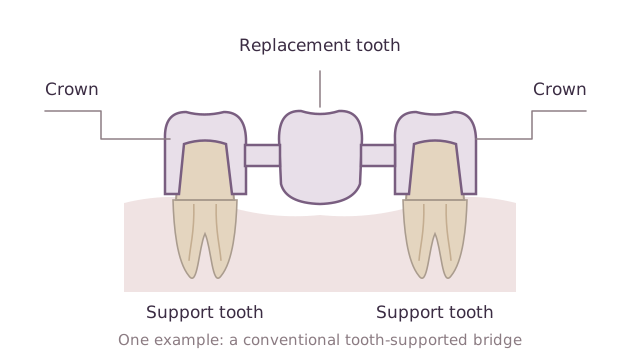
A conventional three-unit bridge uses crowns on adjacent teeth to support an artificial tooth across a gap.Simplified illustration · not a treatment recommendation.
02
Compare the whole journey
A headline price or appointment count rarely tells the full story.
1
Ask about the temporary tooth
Understand what you will wear while treatment or healing is in progress, especially when the gap shows when you smile.
2
Separate the items
For an implant, ask whether the estimate includes surgery, the connecting component and the final tooth. For a bridge, confirm its design and supporting teeth.
3
Include future repairs
Ask how a loose, chipped or worn component would be assessed and repaired. Neither option removes the need for regular dental review.
03
Keep the alternatives visible
The decision is not always between only these two treatments.

A removable replacement
A partial denture may be worth discussing, particularly where several teeth are missing or a fixed replacement is unsuitable.
Reviewing the gap
In selected situations, monitoring a space may be reasonable. Ask about the effect of waiting in your particular mouth.
An individual recommendation
Request a reason for the preferred option that refers to your teeth and priorities, rather than a claim that one treatment is always best.
A little more detail
Your questions, answered.
No treatment has a lifetime guarantee. Implant health and the condition of its attached tooth both require review; components may need repair or replacement.
No. Designs differ. Ask whether a conventional or adhesive bridge is suitable and exactly which teeth would be involved.
A photograph may help explain your concern, but an examination and appropriate records are needed to assess support, bite and health.
Sources & how to use this information
This page provides general education, not a diagnosis or a personalised treatment plan. Ask your treating clinician how it applies to you.

Keep exploring
Your next useful read.

Your next chapter
Start with a conversation.
Bring your questions. Understand your choices. Decide with clarity.
Consultations at Yoyime Clinic · Deira, Dubai

