Specialist dentistry, shaped around you.
 Consultations at Yoyime Clinic · Deira, Dubai

Your concern · Loose dentures
You should not have to plan your day around a loose denture.
Slipping, rubbing and uncertainty while eating can affect much more than your teeth. A fit assessment can help identify whether adjustment, repair, relining or a different design is appropriate.

Discuss this with Dr. Aliveni Sowjanya · Specialist Prosthodontist

01
Bring with you
Your denture and any broken parts
02
Avoid
Home reshaping or household glue
03
First step
Check fit and the tissues underneath
01
Identify the moment it lets you down.
Specific examples help make the assessment useful.

Eating, speaking or soreness
Describe when the denture lifts, clicks or rubs, and whether the problem is new. Explain which foods you avoid and whether adhesive use has increased. Bring any previous denture that fitted more comfortably.
Check more than the denture
The supporting tissues can change shape over time. The denture itself can also wear or break. Assessment needs to consider both the appliance and the health of the mouth.
A closer look
A closer look at a removable implant-retained denture.
The attachment housings are visible on its fitting surface. This is one possible design, subject to assessment—not a fixed bridge.

How it works · simplified
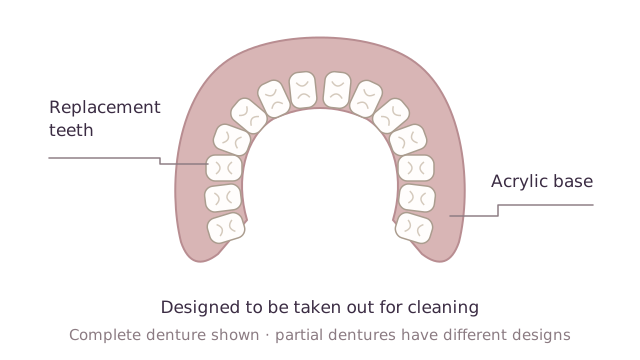
A removable complete denture has replacement teeth attached to an acrylic base. Designs vary by the jaw and clinical situation.Simplified illustration · not a treatment recommendation.
02
A new denture is not the only possible answer.
The cause determines which options are reasonable.
1
Adjust, repair or reline
Some problems may be addressed by a professional adjustment, repair or renewing the fitting surface. These approaches cannot correct every issue; the overall condition and design still matter.
2
Replace or reassess support
A worn or unsuitable denture may need replacement. Implant retention may be considered for suitable patients, with a separate assessment of surgical needs, cost, hygiene access and ongoing component maintenance.
03
Protect comfort while arranging care.
Do not try to solve a persistent fit problem by adding more adhesive.

Keep care gentle and consistent
Clean your denture using advice appropriate to its material. Avoid hot water and abrasive products. Continue caring for the gums and any natural teeth, and discuss overnight removal with your dentist.
Ask for a realistic adjustment plan
New dentures can require adaptation and follow-up adjustments. Clarify which reviews are included, what difficulties to report and when you should return instead of trying to tolerate continuing soreness.
A little more detail
Your questions, answered.
Adhesive may assist some dentures, but it is not a substitute for correcting a poor fit. Increasing dependence on adhesive is a reason to arrange an assessment.
Not always. The specialist will consider whether repair, adjustment or relining is appropriate before discussing replacement. Some worn or damaged dentures cannot be predictably improved.
Implants can support certain fixed or removable designs, but suitability varies. Ask about surgical requirements, cleaning access and future repair needs rather than choosing on the word “fixed” alone.
Persistent soreness needs assessment. Contact a dentist for advice, particularly if there is a sore area that is not healing. Do not file the denture or use household adhesives yourself.
Sources & how to use this information
This page provides general education, not a diagnosis or a personalised treatment plan. Ask your treating clinician how it applies to you.

Keep exploring
Your next useful read.

Your next chapter
Start with a conversation.
Bring your questions. Understand your choices. Decide with clarity.
Consultations at Yoyime Clinic · Deira, Dubai

